Showing posts with label science fiction. Show all posts

Sunday, February 14, 2010

Review: Daemon by Daniel Suarez

Title: Daemon
Author: Daniel Suarez
Copyright: 2009
Publisher: Dutton Adult
ISBN:0525951113


Notes: first book in a series, followed by Freedom.

Intriguing and Exciting Beginning; Story Comes Off the Track at the Midway Point - 3 stars - a book review

Daemon has an irresistible premise: upon the death of computer mastermind, Matthew Sobol, a computer virus type is released that wreaks havoc on the technology based world. Spread out (unknowingly) over thousands of computers, Sobol's Daemon is constantly checking online news websites for key words and phrases which, when triggered, unleash a new plague of technological insanity including stealing stocks and major business' money, recruiting members to his cause, and releasing alternative media. With Sobol already dead, it becomes increasingly impossible to stop the mayhem as everything is already in motion and nobody is directly controlling the direction of the Daemon.

The first half of the book is a wonderful techno thriller. During this early stage of the book, Suarez gives sufficient pertinent information about the inner working of the Daemon searching news sites and the logical progression of what terror is unleashed. The reader has full knowledge of each step of the Daemon's "thought process" and, although some suspension of belief is necessary, everything makes sense. Unfortunately, once the Daemon becomes so big and powerful; and a chunk of time elapses without any information provided to the reader, the book becomes much more of suspension of all belief. Whereas the first part of the book the reader feels like he/she is in control and knows everything that is going on, the last half of the book there is so much going on behind the scenes with only minor (and insignificant) views of Sobol's "army" doing things they don't even know why they are doing them. Each person in Sobol's "army" has no clue what he or she is doing, only a brief piece of the puzzle (i.e. take this mechanized part to location X). While this story telling mechanism works to push the story, it loses emphasis with the reader as to the power of the Daemon brainchild Sobol. At the beginning of the book I thought Sobol was a pure mastermind supervillian genius. By the end of the book, I really did not care much for the dead architect as the story shifted dramatically from a techno thriller to a simple action adventure story of nearly impossible proportions.

The characters in Daemon are unique and suffer many trials and tribulations. The best characters were the ones who thought they were in control and making headway towards stopping Sobol's Daemon only later to find out they were only a pawn in the master plan. The emotional responses in these characters were written well, and the characters had my full empathy.

Daemon, for the most part, is a tightly written techno thriller. I may be a bit too critical because I recognize how difficult it can be to accurately and completely write about the exponentially expanding influence of the Daemon; I only wish the entire book was a solid as the beginning. If you are looking for a solid techno thriller from beginning to end you might look elsewhere; however, if you like techno thrillers and action adventure you have come to the right place.

You might also check out Peacemaker, by Dan Ronco, for a similar techno thriller on the doomsday scenario with technology leading to societal downfall.

Good reading,

Plants and Books

Saturday, December 19, 2009

The Amazing Avatar


If you haven't seen Avatar yet, I don't even want to know you. I took off work Friday morning and went and saw it with my wife. We went to the 3D version; but not the IMAX version. My wife tends to feel a little sick at certain movies with a lot of camera movement (i.e. Terminator Salvation) so went to the 3D version only. I'll probably go back someday (soon) and check out the IMAX on my own.

Needless to say, Avatar was an amazing experience. It almost lived up to the epic trailer; and, had the trailer been only slightly less epic the movie would have exceeded my expectations. As it stands, Avatar met my expectations in every single way.

The Colonel was classic in his warmongering ways and his dialogue was priceless. He was easily my favorite character. The main characters associated with the Avatar program were all believable and well done. The world building was nothing short of incredible.

If you haven't seen Avatar yet, you are doing yourself an injustice. My wife loved it and she typically is not a fan of the science fiction/fantasy genres. After the movie ended I started thinking about the entire world of Pandora and the wealth of storytelling that could occur. There could easily be a great, long running science fiction/fantasy fiction series with the world and the cultures. I wish it was...

Good viewing,

Plants and Books

Friday, November 27, 2009

Most Epic Movie Ever?

If, somehow, the upcoming movie Avatar bombs in the box office, it will still have had the most epic movie trailer... ever.


Good viewing,

Plants and Books

Thursday, May 21, 2009

Review: Orphan's Triumph by Robert Buettner

Title: Orphan's Triumph
Author: Robert Buettner
Copyright: 2009
Publisher: Orbit Books
ISBN: 0316001759

Notes: 5th book in the Jason Wander series


Amazon|Borders|B&N


Everybody Was Somebody Else Before the War - 5 stars - a book review
"Though Father of the great victory, I was laid upon the battlefield of Mantinea, bleeding from my wounds. I commanded my soldiers to lift me up, that I might see my orphans triumph, and I bade them make a lasting peace. But I died too soon to see these things, as all soldiers do."

-Epaminondas' Lament, attributed to Xenophon, ca. 364 BC (an excerpt from the opening of Orphan's Triumph.

True to form, Robert Buettner delivers in the finale of the Jason Wander series. Picking up at the conclusion of ORPHAN'S ALLIANCE, the United Human forces are ready to launch the ultimate counter stroke in the battle against the slugs that has raged on for four decades. At the heart of the novel is Jason Wander, the orphan who has stumbled his way to the position of Lieutenant General, much to the dismay of everyone. Wander was the first to encounter a slug and is determined to be the last one to see them alive. Along the way, through the entire series, he has sacrificed much, and lost even more.

ORPHAN'S TRIUMPH explores the price of command and the price of a life long service to the military as Wander comes to terms with what is necessary to win at all costs. As expected, the personal commentary by Wander in this first person account is raw and genuine. The voice is unmatched and deeply personal. As in ORPHAN'S ALLIANCE, there were times of true emotional responses from me while reading some of the passages, which proves the depth of this military science fiction installment.

The cast of characters includes those that readers of the series have come to appreciate (and love) including Ord, Mimi, Jude, Howard Hibble and his merry band of "Spooks," and Aud. Forty years of war has certainly had an effect on these people and as the end of the Slugs or the end of Humanity looms they will have to reconcile with each other and show the worth of their friendship/relationship. Buettner excels in casting his believable characters in situations that are, at times, excruciating and elegant to read, all at the same time.

ORPHAN'S TRIUMPH, as well as the entire series, is not to be missed. In the spirit of Robert Heinlein, ORPHAN'S TRIUMPH is today's commentary on war, exploration, and personal sacrifice.

Good reading,

Plants and Books

Wednesday, May 6, 2009

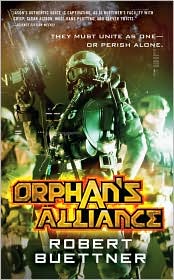
Review: Orphan's Alliance by Robert Buettner

Title: Orphan's Alliance
Author: Robert Buettner
Copyright: 2008
Publisher: Orbit Books
ISBN: 0316001740


Notes: Fourth book in the Jason Wander series

Amazon|Borders|B&N

The Price of War, The Price of Humanity - 5 stars - a book review

"Nearby Waterloo, I saw a Sergeant of Artillery seated upon his caisson, which the rains had mired in the road ditch. His eye had been shot out, and one of his mean, whoes leg was off, wept beside him. The Sergeant complained that Prussian cavalry had bypassed them. He said, with some heat, "Our own allied abandoned us like orphans!" I told him straight, "in this hell, better an orphans' alliance than no alliance at all."

-Remarks at the annual Waterloo Dinner of 1812, attributed to the Duke of Wellington (an excerpt from the beginning of Orphan's Alliance)
After establishing an uneasy alliance with other human colonies on earth like wars in the previous installment (ORPHAN'S JOURNEY), Jason Wander finds himself playing the role of diplomat and warrior, a balance the Wander has had difficulty (and great success) doing in the past. Using interstellar travel methods similar to wormholes, Wander planet hops to build strengthen Earth's alliance against the never ending confrontation with the Slug armada that always seems to be knocking at the doorstep, leading to a beautifully thought out and wonderfully executed battle.

Robert Buettner has created a world that is believable and has explored a new aspect of humanity in each installment of the Jason Wander series. In ORPHAN'S ALLIANCE he tackles the price of war and the alliances of humans with personal interests with a war that hinges loosely on one more battle.

Buettner brings the cast of characters back that readers have grown fond of including Ord, Jude, Munchkin, and Howard. ORPHAN'S ALLIANCE brings a whole new element to his series with some true feeling, hard hitting emotions to the characters and their actions. As in every war, death strikes close to home and the emotional responses are touching to say the least. There are few books that I have had a true emotional response to, and Buettner achieved this with me not once, but twice toward the end of the book. Negating the rest of the other profound achievements in this book, these two moments alone are worth the time invested in reading this book.

Highly recommended.

Good reading,

Plants and Books

Monday, April 6, 2009

Review: Orphan's Journey by Robert Buettner

Title: Orphan's Journey
Author: Robert Buettner
Copyright: 2008
Publisher: Orbit Books
ISBN: 0316001732


Notes: Third book in the Jason Wander series

Amazon|Borders|B&N


The Hero We Deserve and the Hero We Need - 4 stars - a book review
"Patton, himself, pinned my Purple Heart on my pillow today. I told him our Shermans were coffins. Undergunned, underarmored. The gasoline engine makes them rolling bombs. Still, I took on a German Tiger. My boys burned alive. I cried, and I thought he'd slap me. But he patted my shoulder and whispered, "Son, the army's a big family. But command is an orphan's journey." Then that SOB cried with me."

-Tank Commander's letter from France, December 1944 (an excerpt from the beginning of Orphan's Journey)
Brief Synopsis:
The hero of Robert Buettner's military science fiction series returns in the fourth installment of the Jason Wander series. ORPHAN'S JOURNEY begins right where ORPHAN'S DESTINY ended: with the capture of a slug vessel. Jason Wander's godson appears to be the only human that might have the reflexes to pilot the alien craft. In a test run, everything goes wrong and Jason is once again thrust into a situation that is beyond his control; but not beyond his command. The vessel essentially goes on autopilot and crash lands on an alien planet that seems analogous to our own earth. As Jason and his small crew learn about the cultures and battles occurring on this planet, the slugs make yet another appearance and Jason must once again rally the troops in a battle that seems unlikely to be won.

Overall Impressions:
Out of all the Jason Wander books so far, ORPHAN'S JOURNEY is the weakest; however, it is still a worthwhile read and creates a beautiful story arc as to where the series is going. There is less internal struggle portrayed in the mind of Jason Wander, now that he lacks a Commanding Officer. Some of the best and most classic moments of the first couple of books were the commentary about the nature of command, and ORPHAN'S JOURNEY lacks this aspect. However, there are several comparisons drawn and examples from our history. Eisenhower is mentioned several times, and I view this as Jason Wander growing and maturing. The coming of age story is really starting to become much more prevalent. At the conclusion of the book it becomes obvious where the series is going and the impending war between man and slug.

Jason Wander is a hero in every sense of the word; and, one of the most thought provoking themes in this series is the price of heroism and the nature of being a hero. Jason often appears to despise his acts of heroism and almost attributes them to shear luck or to the units he commands.

ORPHAN'S JOURNEY is an authentic work of human compassion and it triumphs in the glimpse portrayed of the fundamental necessity to survive.

It is also impossible to deny the cover art by Calvin Chu.

Good reading,

Plants and Books

Thursday, March 26, 2009

Review: Carbon Copy: Alpha Man by Gary Turcotte

Must... Suspend... All... Belief... - 2 stars - a book review

I did not enjoy reading CARBON COPY: ALPHA MAN. When reading science fiction I do not mind suspending belief as long as it is reinforced with solid ideas and some level of plausibility. Unfortunately, CARBON COPY: ALPHA MAN forces the reading to suspend all possible belief with absolutely no level plausibility. The science is rudimentary and impossible to "buy into."

The characters are introduced haphazardly with no real background and explanation for their "elite skill set." For example, the opening sentence:
"Call me Derek 008. I'm a former secret agent of a major world power. I'm being pursued by teams of secret agent hunters. Most of the Nations want me alive. Some Nations want me dead. After this book is published, I will be hunted like a snake by a mongoose."
This is just a small example of the author pumping up the "excitement" without any real explanation or background to develop the character.

The storyline of CARBON COPY: ALPHA MAN is so far out of left field it is unbelievable. I do not mind stories that fit that description, as long as they are executed well; which unfortunately, this book is not. The story introduces so many varied plot lines of equally outstanding and fantastic nature. The story is all over the place and difficult to manage as a reader.

The reason I gave this book two stars (instead of one) is because I could see myself recommending CARBON COPY: ALPHA MAN to a mature young reader to possibly peak his or her interest in the science fiction genre. There is some vulgar language but nothing unmanageable for a mature reader.

Your best bet? Pass on this book.

Good reading,

Plants and Books

Sunday, March 22, 2009

Review: Orphan's Destiny by Robert Buettner

Title: Orphan's Destiny
Author: Robert Buettner
Copyright: 2008
Publisher: Orbit Books
ISBN: 0316019135

Notes:
Second Book in the Jason Wander series

Amazon|Borders|B&N

Different Plot. Different Location. Different Mission. Same Jason Wander. - 4 stars - a book review

"A Confederate sharpshooter's ball slew our drummer today, as he took breakfast on a fair July morning. The lad joined up when his parents died, and had not passed fourteen. They say it is a soldier's lot to die young and unexpectedly. Or to live and forever question God why he was spared. For me, should I live, I shall ask what cruel God makes death an orphan's destiny."

-True Occurrences During the Great Battle at Gettysburg; Recountings of a Soldier of the Sixty-first Ohio Infantry (excerpt from the opening of Orphan's Destiny).

Brief Synopsis:
After eradicating the slug force on Jupiter's moon, Ganymede, Jason Wander returns to an earth on the brink of economic collapse. The leaders of earth are declaring that the slugs have been completely annihilated and pose no additional threat; thereby transitioning to a post-war economy of reconstruction. Needless to say, Jason Wander is a General out of his comfort zone (if he ever had one). Then, the slugs come back with an armada for a full scale assault on the planet earth. The problem? Earth is not ready to fight another war and has only limited resources and no options to possibly win. Sounds like the odds Wander is used to.

Overall Impressions:
ORPHAN'S DESTINY is drastically different from its predecessor, ORPHANAGE. This addition to the series focuses a bulk of the prose toward politicking and the things that Jason has staunchly stated he cares nothing about; however, duty is duty. The final act focuses on what ORPHANAGE was all about: the infantry men doing whatever it takes to get the job done. While the plot elements may be different, the voice of the story is largely commentary on military issues and personnel. It is refreshing that despite the change in locale and mission, the story remains relatively comfortable in the tradition of military science.

While the reader must suspend some belief at the areas of science and realism, there is a wonderful tale woven on earth and in space. Some areas of science (especially in space travel and engine capacities) were only glossed over and not given proper face time, it is forgiven as I wouldn't expect such from a purely militaristic science fiction story. This book is not about science or space travel or futuristic technologies; it is about the personnel that harness these abilities; and for that alone, Buettner exceeds expectations.

Wander is one of the most interesting characters, and his development (along with the development of characters introduced in ORPHANAGE and a host of new characters) is remarkable. At every turn Wander reinforces his ideology while still learning and growing every step of the way. Obviously reading ORPHANAGE will prove to provide a better reading experience, but this book is one that shouldn't be missed.

Good reading,

Plants and Books

2009 Hugo Nominations Announced


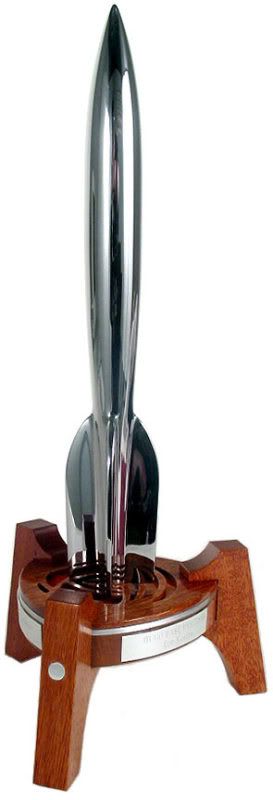
The 2009 Hugo Award nominations were announced on March 19, and once again, I have read or seen few of them; although many of the writing nominees are on my TBR pile. Personal notables include:
  • Anthem by Neil Stephenson - Best Novel - this has been on my TBR pile since it was published;
  • Zoe's Tale by John Scalzi - Best Novel - I have read the first entry in this "series," Old Man's War; but don't know if I will followup with the other entries;
  • The Dark Knight - Best Dramatic Presentation, Long Form - a shoo-in in my opinion, since it is one of the best movies I have ever seen;
  • WALL-E - Best Dramatic Presentation, Long Form - a wonderful, visually stimulating story that tells a compelling tale;
For more information and category links check out the Hugo Awards Wikipedia entry. I typically read several of the previous winners and nominees each year. I frequently view the comprehensive list of Novel entries for both the Hugo Award for Best Novel and the Nebula Award for Best Novel.

Good reading,

Plants and Books

Monday, February 16, 2009

Review: Orphanage by Robert Buettner

Title: Orphan
Author: Robert Buettner
Copyright: 2008
Publisher: Orbit Books
ISBN: 0316019127

Notes:
First book in the Jason Wander series


Amazon|Borders|B&N


Military Science Fiction for the Rest of Us (4 stars) - a book review
We crabbed shoulder to shoulder down cargo nets to our landing craft bucking in the Channel, each GI's bilge-and-sea-soaked boots drenching his buddy below. In that moment I realized that we fight not for flags or against tyrants but for each other. For whatever remains of my life, those barely met strangers who dangled around me will be my only family. Strip away politics, and, wherever or whenever, war is an orphanage.

-Anonymous letter fragment, Recovered on Omaha Beach, Normandy June 1944 (an excerpt from the beginning of Orphanage)
Brief Synopsis:
The story starts with Jason Wander, a somewhat misguided youth with two options: join the military or go to jail. Enter the devastation caused by the alien race later termed as "the slugs." The story follows Wander and his exploits in basic training and the planning behind the first counter offensive against the slugs on their base on one of Jupiter's moons.

Overall Impressions:
ORPHANAGE, by Robert Buettner, may remind many readers of STARSHIP TROOPERS, by Robert Heinlein, and rightfully so. I have seen some discussion about how it was written as a tribute or to STARSHIP TROOPERS. The basic plots are the same, but they are different enough for mutual appreciation.

As a side note, STARSHIP TROOPERS is one of my favorite books. I judge military science fiction on two things:
  • How often the phrase "bought the farm" is used; and,
  • How many moments there are that are only funny when taken outside the context of the military and wartime.
While somewhat superficial, at face value you can derive a lot from military science fiction from those two criteria (and by no means am I serious that a book like this is only good based on these two things; especially since ORPHANAGE only says "bought the farm" once). For one, even though ORPHANAGE is set in the future, the moments that are only humorous outside the context of war, only bring a real time element to the book. It is easy to relate to a story, however far into the future it may be. Believability is incredibly important, and by using elements that are prevalent in today's society, an author (in this case Buettner) makes the story believable and easy in which to relate.

More importantly than the plot, Buettner has created a cast of characters that go on a roller coaster of emotional responses. Wander has superior officers and friends that he interacts with that the reader with which the reader becomes attached. The characters are given countless moral dilemmas that add to their depth. Upon the invasion of Jupiter's moon, war becomes war, and with casualties amounting the way Wander and the characters respond is remarkable. Promotions, demotions, and stress exacerbate the chaos that is war. ORPHANAGE has everything that a military science fiction book should: believable and memorable characters, a tragic premise, and lots of action.

Closing Comments:
One problem I have with the book is the fact that it is written in first person from the perspective of Jason Wander. Unfortunately, as explained previously, there are many great characters and I would have liked to hear more of their internal dialogue. However, I do not believe the story would be as compelling if not told from Wander's perspective. I normally do not prefer first person stories, but ORPHANAGE is a wonderful exception.

Another thing that separates ORPHANAGE from STARSHIP TROOPERS is the fact that ORPHANAGE is just the start of a series. At the conclusion of this book the reader only has more to look forward to.

Recommendations:
If you enjoyed these books, you will enjoy ORPHANAGE:
  • STARSHIP TROOPERS by Robert Heinlein; and,
  • THE FOREVER WAR by Joe Haldeman

Good reading,

Plants and Books

Sunday, January 25, 2009

Review: The Man Who Folded Himself by David Gerrold

Title: The Man Who Folded Himself
Author: David Gerrold
Copyright: 1972, 2003
Publisher: Ben Bella Books
ISBN: 1932100067

Notes:
Nominated for the Nebula Award for Best Novel, 1973
Nominated for the Hugo Award for Best Novel, 1974

Amazon|Borders|B&N


A Wonderful Time Travel Journal - A Saga of A Man Against Time (and Himself) - 5 stars - a book review

Brief Synopsis:
The main character (and one of the only characters), Daniel Eakins is presented with a unique belt that was entrusted to him after his Uncle Jim passed away. Daniel discovers the belt has the ability to transport the wearer throughout time, which Daniel quickly learns how to use. After using his time machine for the first significant time, he is greeted by himself, one day later. During his first temporal jump, Daniel goes with himself (referred to as Don) to the racetrack where they quickly win by betting on horses, at which point Daniel begins to understand the immediate gratification allowed by time travel. Of course, after traveling back to his original time period, Don departs and Daniel is left to become Don the next day when he waits to greet the Daniel from his past. Upon returning to the track with Daniel, he starts to wonder about paradoxes and begins to realize the awesome power, and encourages Daniel to double the initial bet, seeing what would happen to make more money. He then encounters a Don to his Daniel, who has come back in time to warn him not to attract too much attention. At the internal dialogue that follows this encounter is any indication of the confusion Daniel (and the reader) is to experience, it is only the beginning, as Daniel proceeds to live life and encounters himself all the time, and many times during his time travel he encounters several versions of himself.

THE MAN WHO FOLDED HIMSELF is a journal written by the main character about his adventures, catastrophes, close encounters, hi jinx, and personal reflection through time.

Overall Impressions:
THE MAN WHO FOLDED HIMSELF is extremely well written. With multiple permutations of the main character, Daniel, interacting with himself, there are times where there are long portions of internal dialogue and debate about time travel, which is confusing, but written in such a way that it is easy to follow the train of thought.

While a central function of the book, time travel is not the focus of the story. The story is about the time traveling man, and how he lives with himself (both externally as in the case of interacting with himself and internally as in the case of him dealing with his emotions). As one might speculate, being the singular time traveling agent can be a lonely existence. The story revolves around Daniel's isolation and his choices in dealing with that solitude. The author, David Gerrold, creates some interesting, and possibly controversial, situations that are still believable and created in such a way to inspire a sympathetic response from the reader. It is in these moments that literature really pushes the envelope in speculation and emotional responses from the readership. I personally guarantee an emotional response one way or another from reading this book, a quality to which all literature should aspire.

Closing Comments:
The 2003 edition of THE MAN WHO FOLDED HIMSELF has a wonderful introduction titled The Author That Folded Me, by Robert J. Sawyer (a Hugo and Nebula Award winner) that discusses the impact this book had on him when he first read it in 1972. It is near inspiring to read these few pages written by someone who has achieved such a high stature in the world of science fiction and then credits his inspiration and success to David Gerrold.

There is also an Afterward by Geoffrey Klempner that should be read by all the science nuts and those looking for further discussion on time travel and philosophy. He also includes several recommended readings for further discussion and learning.

Finally, there is an Author's Note after the conclusion of the book which is equally fascinating and interesting as he discusses the difficulty in writing the gay sexual sequences of the central character and relates it to his having (or not having) a "gay agenda" as a gay man himself. There are many negative reviews out on the internet that condemn this book and claim it is "great stuff if you're looking to push your teen boys towards the broody wasteland of Colombine" and other implications that are simply not true. As Gerrold says himself in the Author's Note:
"The story isn't about being gay or straight, male or female, or any other specific condition. It's about being human, and dealing with the transfinite possibilities of life - all the choices before us when we exist only as an unwritten tale."
If that doesn't sum it up, I don't know what will.

I go out of my way to mention these three unrelated to the main story because they only enhance the overall reading experience. The entire publication is an experience from beginning to end, and is what all literature should attempt to achieve.

Some further commentary (spoiler warning): As mentioned above, there is some negative publicity surrounding this book. I believe it to be frustrating because people latch on to a controversial idea that is presented and somehow this detracts from the true message. For example, this post on a Science Fiction and Fantasy forum I frequent:
"And yeah, it is basically a time travel story about a man who travels back in time to have sex with himself."
Now seriously, this one point that is extrapolated throughout the story can hardly be considered the focal point of the story. To suggest otherwise is simply ignorance or flaming. I would think that this would be obvious to anyone except the casual reader, but apparently, it is not so obvious. One of the fundamental charges (or expectations) of good science fiction is to speculate on possible worlds that do not exist and the reactions of humans (and humanity) given the described circumstances. I'm not suggesting that I would follow the choices Daniel Eakins made, but the speculation behind THE MAN WHO FOLDED HIMSELF regards the human spirit and need to matter and we travel through time with Daniel Eakins' solitude that chasing time, constantly correcting mistakes, playing with history, and experiencing other tragedies of time travel creates. It may be uncomfortable; but, it is believable, and David Gerrold paints this one derivation perfectly.

Recommendations:
  • REPLAY, by Ken Grimwood - a book I read recently about time travel and also focuses on the isolation of such a gift.
  • ALL YOU ZOMBIES, by Robert Heinlein - I have not read this short story, but it is often associated with the reviewed book in discussions and recommendations. Several people I trust have encouraged me to read this and I have no reasons to doubt their recommendation.
Good reading,

Plants and Books

Monday, January 19, 2009

Review: Unholy Domain by Dan Ronco (5 stars)

It's Fiction; But For How Long?

Throughout the history of the science fiction genre authors have have crafted a story that seems completely unbelievable and remain fiction for only so many years.

Dan Ronco has crafted an energetic and fast paced thriller about the, in my opinion, inevitable collision course of technology and what it means to be a "human." UNHOLY DOMAIN ramps up the plot ten years after the cataclysmic events in PEACEMAKER, the first book in Ronco's series. Enter a world in the middle of global depression and a divided culture (sound familiar already?).

The characters, while not overly deep, are compelling in their actions and their individual encounters. Ronco excelled in crafting a world where there are those fighting for science and technology, those fighting for religion, and those in between just fighting to get by.

I think the most important facets of this novel are the themes and the ideas that will only come more prevalent as we progress as a society, and reading this book makes it that much more obvious that the potential for the "fiction" may only be "fiction" for so long.

A highly recommended techno-thriller.

Good reading,

Plants and Books

Thursday, January 15, 2009

Review: The Family Bones by Kimberly Raiser (4 stars)

A Little Bit of Everything. Overall Good Read.

What do you get when you mix some horror, thriller, suspense, and science fiction all together? You get a well written novel that goes by the name of THE FAMILY BONES, by Kimberly Raiser. Raiser has crafted a short book that is hard to describe, and even harder without spoiling anything.

For a book with so many different elements and a variety of characters, it can sometimes be overwhelming. However, Raiser does a nice job transitioning between the opening terrifying chapters to moving the plot along and developing the characters. In the author's note, she talks about how THE FAMILY BONES was first a short story, and it is obvious reading how where the transition occurs.

I had a lot of fun reading this book. I almost read it in one sitting (and would have had my wife not found me at 2:30 AM in the living room telling me to come to bed). It was a quick, fun, engaging read; and, I'm glad I got the opportunity to read it.

The only drawback to this book is I felt like it should have been longer. As I mentioned, there is a lot of quick character and plot development and there are points where there are pages of information that are sort of out of context with the actions of the plot. Had THE FAMILY BONES been 300 pages I believe it could have been a stronger book.

All in all, this book is definitely worth the time it took to read.

Good reading,

Plants and Books
Sunday, December 28, 2008

Review: Replay by Ken Grimwood (5 stars)

The Finest Speculation. REPLAY Has it All

REPLAY, by Ken Grimwood, is a miraculous journey through time and the human spirit. Grimwood wonderfully exposes the possible outcomes of having advanced knowledge while leading life. What happens when you live the same thirty years over, and over, and over? What makes a life worthwhile? Is it a lifetime of money, fame, or positive interactions with others? What does anything matter if at the end of the "replay" everything just gets erased, except in your memory?

REPLAY is at times an emotional ride of personal reflection while still maintaining a level of intrigue and curiosity that awaits the protagonist. While only science fiction on a basic level (time traveling), there is a incredible amount of speculation about human motivations, given the frame of reference for the characters. This speculation is what truly makes REPLAY a gem.

There is something for everyone in this book. REPLAY is one of those rare books that captures the imagination, the mind, and the spirit of humanity.


Good reading,

Plants and Books

Thursday, December 11, 2008

Review: Peacemaker by Dan Ronco (5 stars)

A Breath of Fresh Air

I finished this book within 24-hours. I almost finished it in one sitting. I was captivated by the interesting and fast paced nature of the plot. The storyline was simple enough, but believable enough to be scary. I am a "hard" science fiction junkie, and I liked how this novel had an element of "hardness" to it, but was not overly complicated with details and really focused on moving the plot forward and creating complicated situations for the compelling characters.

I found the characters to be likable, but obviously flawed. The female characters simply oozed sexuality at every encounter. With the background and preliminary story developed for each character in the opening chapters, it was easy to follow and believe in each move they made and their motivations were expected and not randomly generated.

This book met, and exceeded, my expectations for a first novel. It was short, easy to read, captivating, and unique (which is probably the most important). It was not only unique in the idea of the computer software virus, but unique in the direction that the story heads afterward. It's one thing to create a world shattering event, but it is another thing to take that story in a direction that will become more interesting, both of which Ronco excels in doing. Using the analogy of a post apocalyptic book, I would not want the apocalypse to be the most interesting part of a book. You want the characters reactions and the story of their survival to be the most compelling, which PEACEMAKER achieves in its own right. The "PeaceMaker" virus is just the tip of the iceberg. It is everything else that makes this book worth reading.

I look forward to the rest of this series (I think I read it will be a trilogy) and more to come from Dan Ronco. I'm glad I got in early in his writing career.

Highly recommended. This book was a breath of fresh air compared to the massive numbers of like-minded, similar stories that are churned out each week.

Good reading,

Plants and Books

Review: Darwin's Radio by Greg Bear (4 stars)

Great Bio-Science Fiction. Incredible Look at Humanistic Behavior as Well

Note: Review originally posted at Amazon on July 30, 2006. I am back posting a couple of reviews to see how the "tags" and sorting works.

Greg Bear explores an area of science fiction that is not often written about - biology. There is a significant amount of science revolving around evolution, genetics, virology, and mutation. Bear crafts a magnificent story about these subjects as they apply to the mass population and how we as humans might react to biological issues. What would humans do if the homo sapien species was threatened? What kind of politics would unfold in the local and national level? These are some of the most important issues that Bear addresses and chronicles. It is interesting to read about the hard-science behind the genetics and "viruses" but some of the most facinating parts of the story are the human interactions and watching the loyalties shift and change.


However, there are some suspect parts of this book. One thing that truly bothered me about DARWIN'S RADIO has to do with the writing style. Bear attempts to create cliff-hangers and suspenseful moments that are immediately interrupted with chapter breaks, and then we usually learn about the climax of each incident from a past perspective. I found it difficult to regain the excitement that was built around some particular incidents after a chapter ended only to read about how the incident unfolded five pages later from a character listening to the news or talking to someone who heard about the incident. I wanted Bear to actually write about these parts and not to "recollect" these parts.


There were also some strange scenes (and unnecessary characters) that I could have done without simply because they did not add anything to the content of the book or the development of the characters.


Overall, this is a wonderful work of science fiction. I did have a difficult time getting into the story simply because of some of the extraneous characters (i.e. Saul). However, soon thereafter the biology picked up and the science paved the way to the humanistic encounters and the societal developments.


I certainly recommend this book for science fiction fans and biologists.


Good reading,

Plants and Books

Clicky Web Analytics